


SKU:LIQ-TRC-NAN(EHMC)-500ML
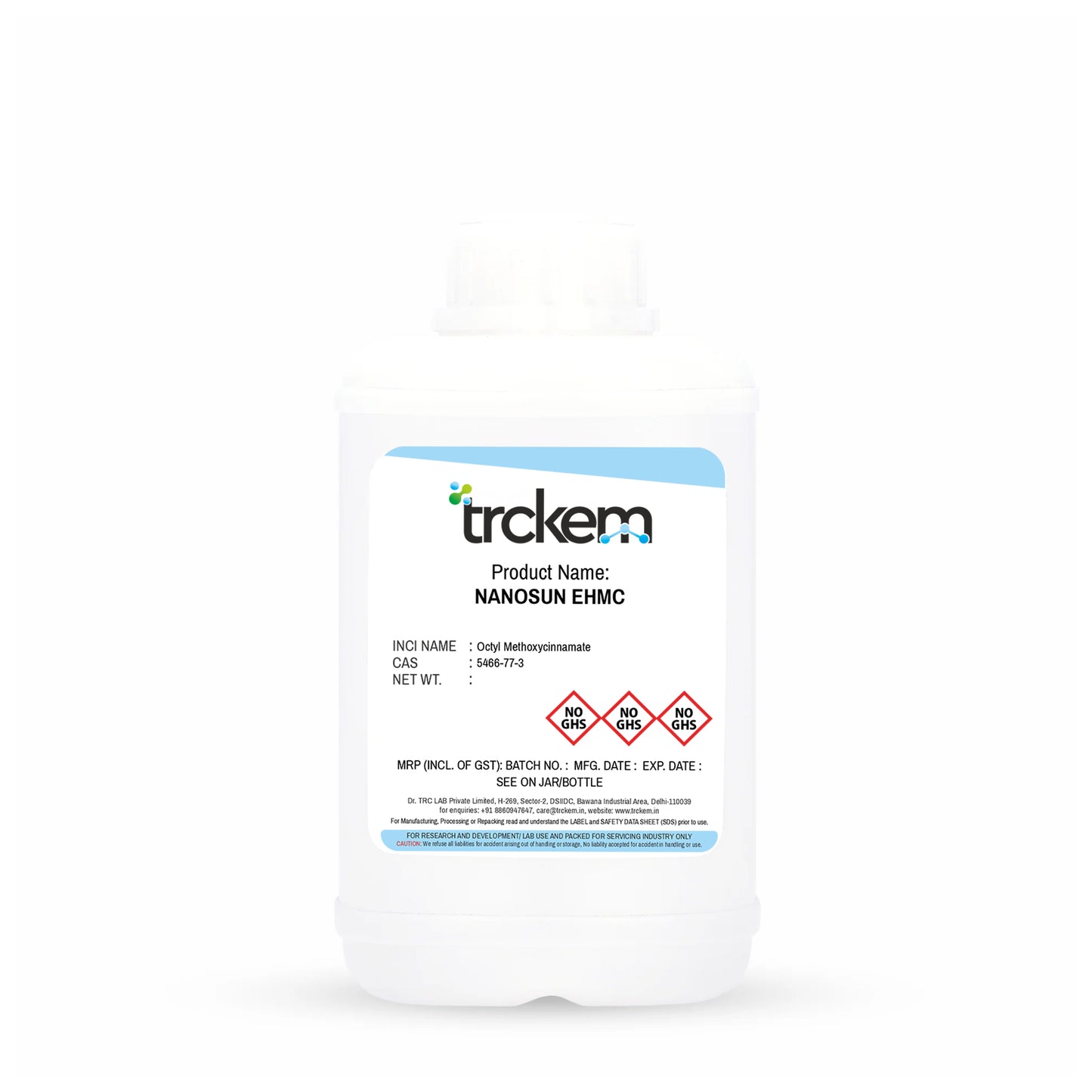
NANOSUN EHMC
For Bulk Quantity:📞 8822636416
Couldn't load pickup availability
NANOSUN EHMC is a widely used organic UVB filter commonly added to sunscreens, lotions, and daily skincare formulas. It absorbs harmful UVB rays, helping prevent sunburn and photoaging while maintaining product texture and clarity. Well-studied and highly compatible, it blends easily with other filters for enhanced broad-spectrum protection in modern cosmetic formulations.
Product Document: Download Now 👇


General Description
NANOSUN EHMC is an oil-soluble organic UVB filter widely used in sunscreen and daily sun-care formulations. Derived from Octyl Methoxycinnamate (OMC), it appears as a clear to pale yellow liquid and is known for its excellent ability to absorb UVB radiation. As a high-performance NANOSUN EHMC, it plays a critical role in protecting the skin from sun-induced damage and premature aging.
In cosmetic and personal care products, NANOSUN EHMC works by absorbing UVB rays and converting them into less harmful energy, helping prevent sunburn and photo-degradation of the skin. Its compatibility with a wide range of emollients and UV filters makes it a preferred choice in modern sunscreen systems. Cosmetic manufacturers frequently BUY NANOSUN EHMC for use in lotions, creams, sprays, and other sun-protection products.
With increasing global demand for effective UV protection, suppliers offering WHOLESALE NANOSUN EHMC support large-scale production while maintaining formulation consistency. Due to its proven efficacy and formulation flexibility, NANOSUN EHMC remains a cornerstone ingredient in professional sun-care development.
Uses in the Cosmetics Industry
- NANOSUN EHMC is extensively used across the beauty and personal care industry, particularly in products designed for sun protection and daily UV defense. Its key cosmetic applications include:
- A primary UVB filter in sunscreen creams, lotions, and sprays, where NANOSUN EHMC provides effective protection against UVB radiation.
- Incorporated into daily moisturizers, foundations, and BB creams to enhance SPF performance.
- Used in water-resistant and long-wear sun-care formulations due to its oil solubility and stability.
- Applied in professional and mass-market cosmetic products requiring reliable UV absorption.
- Cosmetic brands and contract manufacturers often BUY NANOSUN EHMC to meet regulatory and performance requirements for sun-care products.
- Access to WHOLESALE NANOSUN EHMC allows manufacturers to scale production efficiently while maintaining cost control. The consistent quality of NANOSUN EHMC ensures reliable SPF performance across different formulations.
Safety & Handling
- When used within approved regulatory limits, NANOSUN EHMC is considered safe for cosmetic applications. However, standard chemical handling practices should always be followed during manufacturing.
- May cause mild skin or eye irritation in concentrated form.
- Avoid direct contact with eyes and prolonged skin exposure during handling.
- Use appropriate personal protective equipment in bulk processing environments.
- Ensure proper ventilation when working with large quantities of NANOSUN EHMC.
- Manufacturers who BUY NANOSUN EHMC and source WHOLESALE NANOSUN EHMC should adhere to safety data guidelines provided by suppliers to ensure safe and compliant usage.
Storage & Stability
NANOSUN EHMC should be stored in tightly closed containers in a cool, dry, and well-ventilated area, away from direct sunlight and heat sources. Proper storage helps maintain its UV-absorbing efficiency and chemical stability.
Under recommended storage conditions, NANOSUN EHMC remains stable and retains its performance over time. Bulk packaging from WHOLESALE NANOSUN EHMC suppliers is designed to protect the product during transportation and long-term storage. Companies that BUY NANOSUN EHMC are advised to follow standard storage practices to ensure maximum shelf life and formulation reliability.
CAS Number: 5466-77-3
INCI: Ethylhexyl Methoxycinnamate
Composition:OMC consists primarily of the organic UVB filter ethylhexyl p-methoxycinnamate, an ester formed from methoxycinnamic acid and 2-ethylhexanol.
Purity Grade: Cosmetic Grade / UV Filter Grade (≥ 98%)
Appearance: Clear, colorless to pale yellow oily liquid
Solubility:Insoluble in water; soluble in cosmetic oils, esters, alcohols, waxes, and organic solvents
Preservation:Self-preserving; does not require added preservatives under normal use conditions
Raw Material Sources:Petrochemical and aromatic organic synthesis derivatives
Manufacture:Produced through esterification of p-methoxycinnamic acid (or its derivatives) with 2-ethylhexanol, followed by purification and filtration to cosmetic-grade standards.
Animal Testing: Not animal tested
GMO: GMO-free
Vegan: Contains no animal-derived materials
Proposition:Complies with global cosmetic regulations for approved UV filters, including EU Cosmetic Regulation (EC) No. 1223/2009, US FDA Monograph (where applicable), and additional regional sunscreen standards.
Warning:For external use only. Avoid contact with eyes. Not intended for ingestion. Follow regional concentration limits—overuse may cause regulatory noncompliance. Store tightly closed away from heat, sunlight, and ignition sources.
THE STORY OF NANOSUN EHMC

Nanosun EHMC: The UV-B Shield for Everyday Sun Protection
Nanosun EHMC is a globally used UV-B sunscreen filter, known for absorbing harmful UV-B rays responsible for sunburn, tanning, and photoaging.
It is oil-soluble, highly compatible with emulsions, and widely used in sunscreens, day creams, BB creams, lotions, foundations, and outdoor skincare.
A key molecule for enhancing SPF performance.

An Ester-Based UV Filter Engineered for High Stability & Oil-Phase Performance
Nanosun EHMC is created by esterifying methoxycinnamic acid with 2-ethylhexanol, producing a lightweight, oil-soluble UVB absorber.
Key features:
- Excellent photostability
- High UVB absorption (peak ~310 nm)
- Compatible with most oil-phase sunscreen systems
TRCkem supplies cosmetic-grade Nanosun EHMC with high purity for sun-care formulations.

Absorb. Protect. Enhance SPF.
Nanosun EHMC offers multiple sun-care benefits:
✅ Provides strong UV-B protection
✅ Boosts overall SPF value in creams, lotions & sprays
✅ Lightweight & easily spreadable on skin
✅ Highly compatible with other sunscreen filters
✓ Helps reduce sunburn, tanning & photoaging
Used in: sunscreens, day creams, BB creams, foundations, lip balms, outdoor skincare & sports sunscreens.

Reliable & Oil-Soluble — Ideal for Modern SPF Formulations
• Typical use level: 3–10% depending on SPF target
• Add in the oil phase during emulsification
• Works well with: Avobenzone, Octocrylene, Zinc Oxide & other filters
• Stable under normal storage conditions
• Not recommended for baby-only formulations in high amounts
• Avoid overheating (>80°C) to prevent degradation
• Store in sealed containers away from light & heat
Formulator’s Queries, We Answered
1) What is Nanosun EHMC? What is its CAS number and INCI name?
Nanosun EHMC is the trade name you will use for the UV-B filter commonly known as octyl methoxycinnamate / octinoxate. Its INCI name is Ethylhexyl Methoxycinnamate and the main CAS number used in regulatory listings is 5466-77-3
2) What does Nanosun EHMC do in personal-care products?
Nanosun EHMC is a UV-B absorbing organic filter used in sunscreens and many leave-on and rinse-off cosmetics to reduce UV-B-induced skin damage and sunburn. It is commonly combined with other UV filters or photostabilizers to broaden protection.
3) Is Nanosun EHMC the same as “OMC” or “EHMC”?
Yes. OMC (octyl methoxycinnamate), octinoxate, and EHMC (ethylhexyl methoxycinnamate) are used interchangeably in industry literature — they refer to the same chemical family and typical material used as a UV-B filter
4) What concentration is considered safe for consumer products?
The European Scientific Committee on Consumer Safety (SCCS) recently concluded that Ethylhexyl Methoxycinnamate (EHMC) is safe as a UV filter up to 10% in finished cosmetic products when used under the assessed conditions (sunscreen lotion, face/hand cream, lipstick, sprays, etc.). If you plan to market Nanosun EHMC at or above that level, ensure your formulation and labeling follow the jurisdictional safety dossier requirements.
5) What about endocrine-disruption and systemic absorption concerns?
Recent reviews and regulatory opinions note that EHMC shows endocrine-active signals (weak estrogenic and anti-androgenic activity in some studies), and there is evidence that organic sunscreen filters can be systemically absorbed and detected in blood in human studies. Regulatory safety opinions have evaluated those data when setting use limits and conditions. Product developers should rely on up-to-date safety dossiers and post-market surveillance data