


SKU:LIQ-TRC-OLE-500G
Oleic Acid
For Bulk Quantity:📞 8822636416
Couldn't load pickup availability
Oleic Acid is a naturally derived fatty acid that functions as an emollient, surfactant, and penetration enhancer, providing moisturization and improved ingredient delivery in skincare and haircare products.
Product Document: Download Now 👇


General Description:
Oleic Acid is a naturally occurring monounsaturated fatty acid (chemical formula: C₁₈H₃₄O₂). It is one of the most common fatty acids found in both animal fats and vegetable oils, especially abundant in olive oil (hence the name "oleic"). Oleic Acid appears as a colorless to pale yellow oily liquid with a characteristic mild odor. It is non-volatile, insoluble in water, but soluble in alcohol and other organic solvents. In cosmetics, it is often used in its pure form or as part of natural oils.
Uses in the Cosmetic Industry:
- Softens and smooths the skin, making it feel more supple.
- Helps to mix oil and water, aiding in dirt removal.
- Increases the absorption of active ingredients into the skin.
- Helps dissolve other ingredients, especially oils and oil-based actives.
- Helps maintain the consistency and stability of creams and lotions.
- Used in conditioners and treatments to improve hair manageability and moisture.
- Found in natural oil blends (like olive oil, avocado oil) used for skin and hair nourishment.
Hazard:
- Oleic Acid is generally recognized as safe (GRAS) by regulatory agencies like the FDA when used in appropriate amounts.
- In higher concentrations, it can disrupt the skin barrier, potentially causing irritation, redness, or inflammation, especially for sensitive or compromised skin.
- It can be comedogenic (pore-clogging) for some individuals, leading to acne or breakouts.
- May cause mild eye irritation if direct contact occurs.
- Low risk, but inhaling aerosols or sprays containing Oleic Acid may cause mild respiratory irritation.
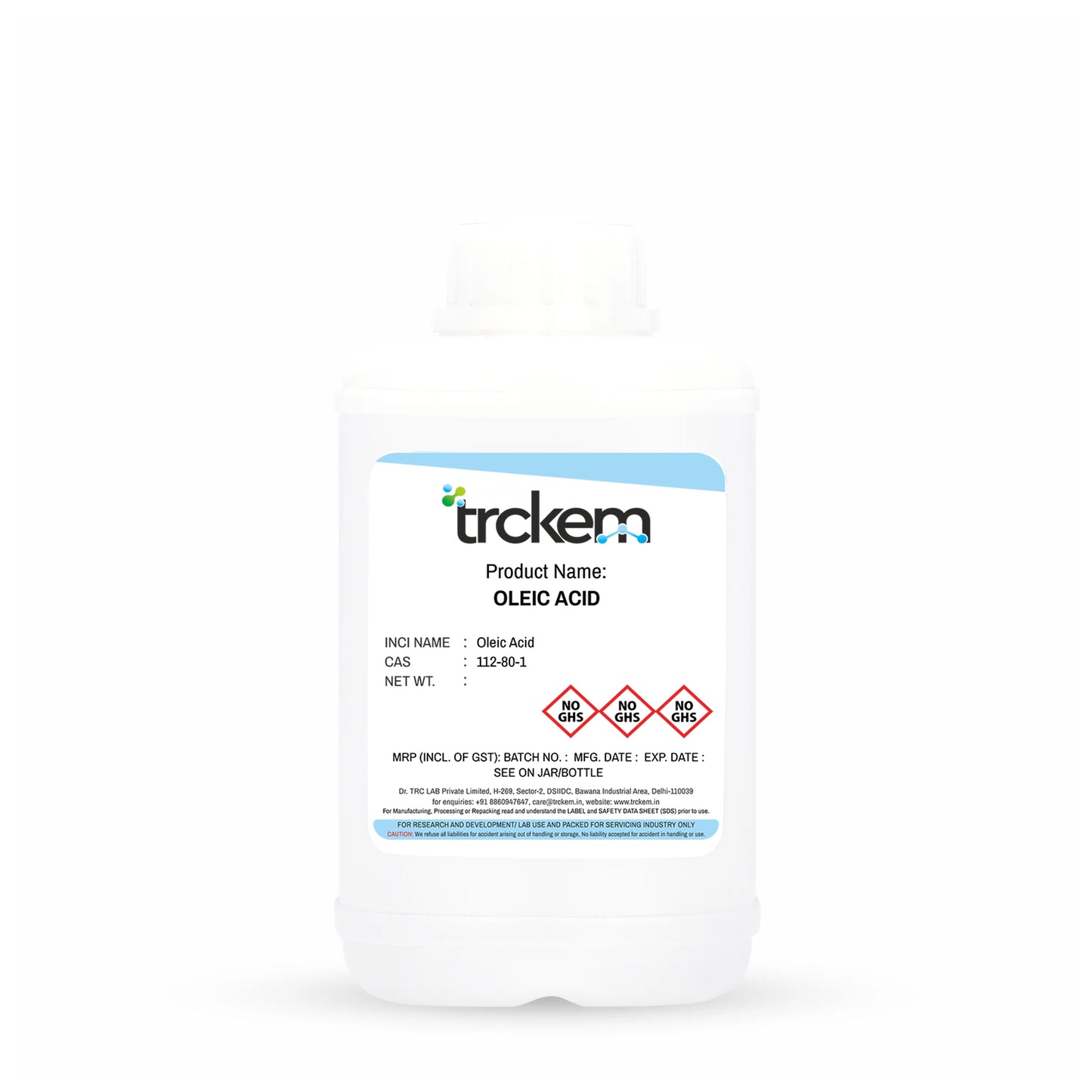
CAS Number: 112-80-1
INCI Name: Oleic Acid
Composition: Primarily cis-9-octadecenoic acid (C18:1), a monounsaturated omega-9 fatty acid.
Purity Grade: Pharmaceutical Grade (optional, depending on supplier)
Purity typically ≥ 99%
Appearance: Clear to pale yellow oily liquid
Solubility: Insoluble in water.Soluble in alcohol, ether, chloroform, and most organic solvents
Preservation: Typically self-preserved due to its chemical nature.No additional preservatives needed, but antioxidants like tocopherol may be added to prevent oxidation.
Storage: Store in tightly closed containers.Cool, dry, well-ventilated area away from direct sunlight and oxidizing agents
Raw Material Sources: Primarily derived from vegetable oils like olive oil, sunflower oil, soybean oil, or animal fats (depending on the source)
Manufacture: Obtained by hydrolysis (saponification) of triglycerides found in natural oils/fats followed by purification (distillation or fractional crystallization)
Animal Testing: Most cosmetic-grade oleic acid is not tested on animals (check supplier certification for cruelty-free status)
GMO: Non-GMO versions are available.
Vegan: Yes, if sourced from plants
Proposition:Not listed as a chemical known to cause cancer, birth defects, or other reproductive harm under California Proposition 65.
Warning: May cause skin or eye irritation in concentrated form.Handle with appropriate protective equipment.
THE STORY OF OLEIC ACID

Oleic Acid: The Skin-Softening Fatty Acid for Rich, Nourishing Formulations
Oleic Acid is a monounsaturated fatty acid (C18:1) widely used in skincare, haircare, and personal-care formulations.
Known for its deep-conditioning, penetration-enhancing, and emollient properties, it helps soften the skin and improve the texture of emulsions.
Common in creams, lotions, soaps, serums, hair oils, and emulsifier production.

Derived from Natural Vegetable Oils Through Hydrolysis & Purification
Oleic Acid is obtained from vegetable oils rich in monounsaturated fats, such as:
• Olive Oil
• Sunflower Oil
• Palm Oil
• Avocado Oil
It is produced by hydrolysis of triglycerides, followed by fractional distillation to yield a high-purity, cosmetic-grade fatty acid.
TRCkem provides Oleic Acid with various purity grades suitable for cosmetic and industrial applications.

Condition. Penetrate. Nourish.
Oleic Acid offers multiple high-performance cosmetic benefits:
✅ Deep skin-conditioning and moisturization
✅ Acts as a penetration enhancer for active ingredients
✅ Enhances spreadability and texture in lotions
✅ Boosts emulsion stability when used in emulsifiers
✓ Adds richness to hair oils & conditioning products
Used in: creams, lotions, serums, liquid soaps, hair oils, cleansing oils, balm formulations & emulsifier synthesis (sodium oleate, potassium oleate).

Versatile, Stable & Easy to Formulate Across Oil-Phase Systems
• Typical use level: 1–15% in skincare
• Oil-soluble → add to oil phase
• Can be neutralized with NaOH/KOH to form liquid soaps
• Improves absorption and skin glide
• Stable under normal conditions; avoid strong oxidizers
• Store in sealed containers, protected from heat & light
• Safe for cosmetic use when formulated properly
Formulator’s Queries, We Answered
1. What is Oleic Acid?
Oleic Acid is a monounsaturated fatty acid that is naturally found in various animal and vegetable oils, with olive oil being one of its richest sources. It has a wide range of uses in personal care products, including skincare, haircare, and cosmetics.
2. How is Oleic Acid used in the personal care industry?
In personal care products, Oleic Acid is primarily used for its emollient, moisturizing, and conditioning properties. It helps to soften and smooth the skin and hair by replenishing natural oils, making it a common ingredient in lotions, creams, shampoos, and hair conditioners.
3. What are the benefits of Oleic Acid for the skin?
Oleic Acid helps in improving skin hydration, maintaining the skin’s elasticity, and reducing dryness. Its soothing properties make it suitable for sensitive skin and dry skin conditions. Additionally, it has antioxidant properties that help protect the skin from environmental stressors.
4. Is Oleic Acid safe for use in cosmetics and skincare products?
Yes, Oleic Acid is generally regarded as safe for use in personal care products. However, as with any ingredient, some individuals may experience skin sensitivity or irritation. It’s recommended to do a patch test before using products containing Oleic Acid, especially for those with sensitive skin.
5. What are the potential side effects of Oleic Acid in personal care products?
Oleic Acid is well-tolerated by most skin types, but excessive use in high concentrations may lead to clogged pores, particularly for individuals with oily or acne-prone skin. It is important to use products formulated with Oleic Acid as directed.
6. Is Oleic Acid suitable for all skin types?
Yes, Oleic Acid is suitable for most skin types, including dry, sensitive, and normal skin. However, individuals with oily or acne-prone skin should be cautious, as its heavy texture could potentially exacerbate breakouts.
7. What is the INCI name of Oleic Acid?
The International Nomenclature of Cosmetic Ingredients (INCI) name for Oleic Acid is Oleic Acid.
8. What is the CAS number for Oleic Acid?
The CAS (Chemical Abstracts Service) number for Oleic Acid is 112-80-1.
9. Can Oleic Acid be used in hair care products?
Yes, Oleic Acid is beneficial for hair care as it helps to nourish the scalp, reduce frizz, and improve the overall texture of hair. It is commonly used in hair oils, conditioners, and styling products.
10. How should products containing Oleic Acid be stored?
Products containing Oleic Acid should be stored in a cool, dry place, away from direct sunlight and excessive heat, to maintain their effectiveness and prevent any degradation of the product.